Introduction
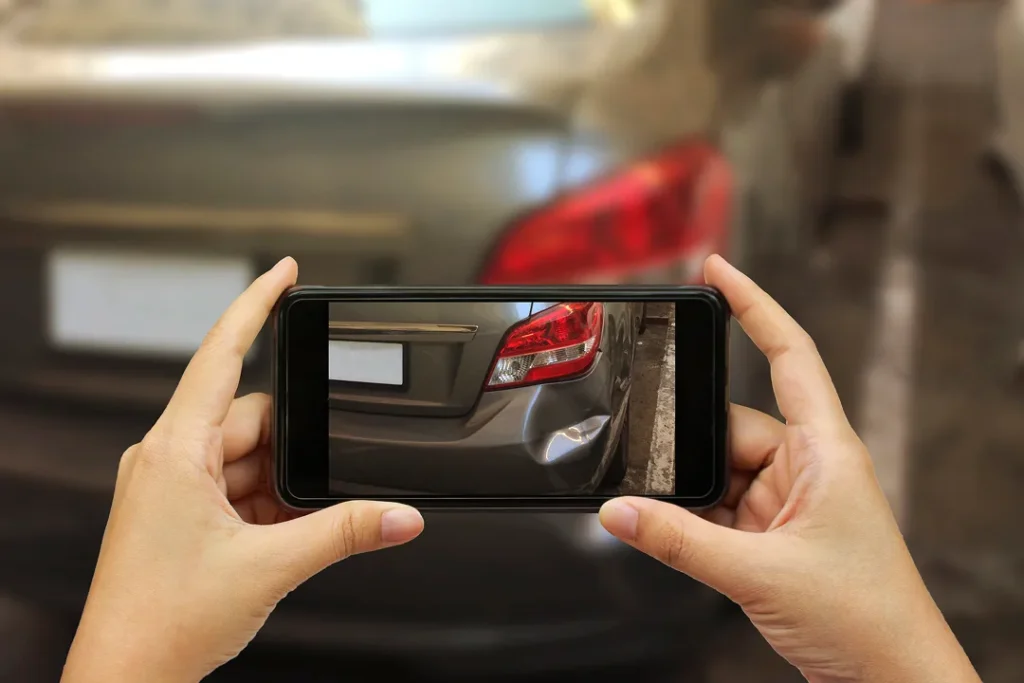
Knowing how to photograph a dent for a quote makes the whole process faster and more accurate. When you send me photos of a dent, those images are essentially my first consultation. The better the photos, the more accurate the quote — and the faster I can get back to you.
I receive dent photos every day, and there’s a clear difference between images that tell me everything I need to know and ones that leave me guessing. A blurry close-up in poor lighting doesn’t give me much to work with. A few well-lit shots from different angles tell me the full story.
This isn’t about having a professional camera. Your phone is more than enough. It’s about knowing what to capture and how.
Why Good Photos Matter
A dent quote isn’t just about size. When I look at your photos, I’m assessing:
- Depth — is it a shallow ding or a deep depression?
- Shape — is it round, oval or a sharp crease?
- Paint condition — any chips, cracks or scratches?
- Panel location — which part of the car is affected?
- Access — can I reach behind the panel?
Poor photos mean I either have to ask for more, or give a wider price range because I can’t see enough detail. Good photos mean a precise fixed quote — often within minutes.
5 Steps to Get the Perfect Dent Photos
Step 1: Clean the Panel
Dirt, dust and watermarks can hide the true edges of a dent or make scratches look worse than they are. Give the area a quick wipe with a cloth before taking photos. You don’t need to wash the whole car — just the damaged area.
Step 2: Find the Right Light
Lighting is the single most important factor. The dent needs to cast a visible shadow so I can judge its depth and shape.
Best lighting conditions:
- Overcast daylight — soft, even light that reveals dents clearly
- Low-angle sunlight — early morning or late afternoon sun creates shadows that highlight the contour
- Street light at night — park directly under a street lamp and the overhead light will show the dent profile
Avoid:
- Direct midday sun — washes out detail and creates harsh reflections
- Shade with no directional light — the dent appears flat
- Camera flash — flattens everything and adds glare
If you’re indoors, angle a bright lamp across the panel at roughly 45 degrees. This mimics the effect of low sunlight.
Step 3: Take Multiple Angles
One photo is rarely enough. I need to understand the dent in three dimensions.
Send at least 3–4 shots:
- Wide shot — shows the full panel so I can see exactly where the dent sits on the car (include the door handle, wheel arch or mirror as a reference point)
- Medium shot — from about arm’s length, centred on the dent
- Close-up — as close as you can focus, showing the dent surface detail
- Angled shot — from the side at a low angle, so the dent casts a shadow and I can gauge depth
If there are multiple dents on different panels, photograph each one separately with a wide shot showing which panel it’s on.
Step 4: Add a Size Reference
Dents can look very different on a screen depending on how close you hold the camera. Without a reference, a 2 cm ding can look identical to a 10 cm dent.
Simple ways to show scale:
- Place a coin next to the dent (a £1 coin is 23 mm — I use this as a reference daily)
- Hold your finger beside it
- Place a bank card or ruler next to the damage
This one small step makes my assessment significantly more accurate.
Step 5: Include Vehicle Details
Along with the photos, send me:
- Make and model (e.g. BMW 3 Series 2021) — this tells me the panel material (steel or aluminium) and helps me plan tool access
- Which panel — if it’s not obvious from the photo (e.g. “rear passenger door”)
- Your location — so I can factor travel into the quote
Quick Checklist Before Sending
Before you hit send, run through this:
- Panel wiped clean
- Good lighting (angled, not flat)
- Wide shot showing panel location
- Medium and close-up shots
- Angled shot showing depth
- Coin or finger for scale
- Vehicle make, model and year
- Which panel is damaged
- Your postcode or town
What Happens After You Send Photos
Once I receive your photos, here’s the process:
- I review the images — checking size, depth, paint condition and access
- I reply with an assessment — whether PDR is suitable and what’s involved
- I provide a fixed quote — not a range, not an estimate, a firm price
- We book a time — I come to your location and complete the repair
Most quotes go out within a couple of hours during working hours. For straightforward door dings, it’s often much faster.
If I need a clearer photo or an additional angle, I’ll let you know exactly what to send.
Common Mistakes to Avoid
Over the years, I’ve seen a few recurring patterns that make quoting difficult:
Too close, no context — A macro shot of the dent surface tells me about paint condition but nothing about size or location. Always include a wider shot.
Flash photography — The built-in flash washes out all shadows and makes even deep dents look flat. Turn it off and use ambient light instead.
Photographing in full shade — If there’s no directional light at all, the dent won’t show its shape. Move to a spot with angled light or wait for better conditions.
Only one photo — A single image gives me one perspective. Three or four photos from different angles give me the full picture.
No scale reference — Without something for size comparison, I can’t tell if the dent is 1 cm or 5 cm. A coin takes two seconds to place and makes a real difference.
The Best Tool You Already Have
Your smartphone camera is more than capable of taking photos that lead to an accurate quote. You don’t need special equipment, editing or filters. Just clean the panel, find good light, shoot from a few angles, drop a coin next to the dent, and send.
That’s it. Five minutes of your time and I can give you an exact price.
Ready to Send Your Photos?
WhatsApp is the fastest way — I can usually see your photos within minutes and reply with a quote the same day.
→ Send photos via WhatsApp → Use the contact form → Not sure if PDR can fix your dent? Read this first
Key Takeaways
- Clean the panel, use angled light, shoot 3–4 angles, add a coin for scale
- Include your vehicle make/model, which panel, and your location
- Good photos = precise fixed quote, usually within hours
- WhatsApp is the fastest way to get an assessment
- No charge, no obligation — I’ll tell you honestly what’s possible